News - Obserwatorium Astronomiczne im. Mikołaja Kopernika

Skip banner

A+ category

In the Evaluation of the quality of research activity for 2022–2025, the Ministry of Science and Higher Education awarded Jagiellonian University A+ rating in the field of astronomy.

Contact

Ul. Orla 171, 30-244 Kraków
Phone: 12 6238 620
For media & schools: press@oa.uj.edu.pl

Facebook icon
 

APOD

Astronomy Picture of the Day
 

Exemplary sky picture from the apod.pl/apod service: a dusty nebula


Study program

Positive assessment by the Polish Accreditation Committee

Hyper-Kamiokande

 Projekt „Hyper-Kamiokande” został zaakceptowany do finansowania w ramach programu „Wsparcie udziału polskich zespołów naukowych w międzynarodowych projektach infrastruktury badawczej” Ministerstwa Edukacji i Nauki.


Night under the Stars

Link to the event website
 

Decorational: Photo of the night sky with the central band of the Milky Way


Meteo

Forecast

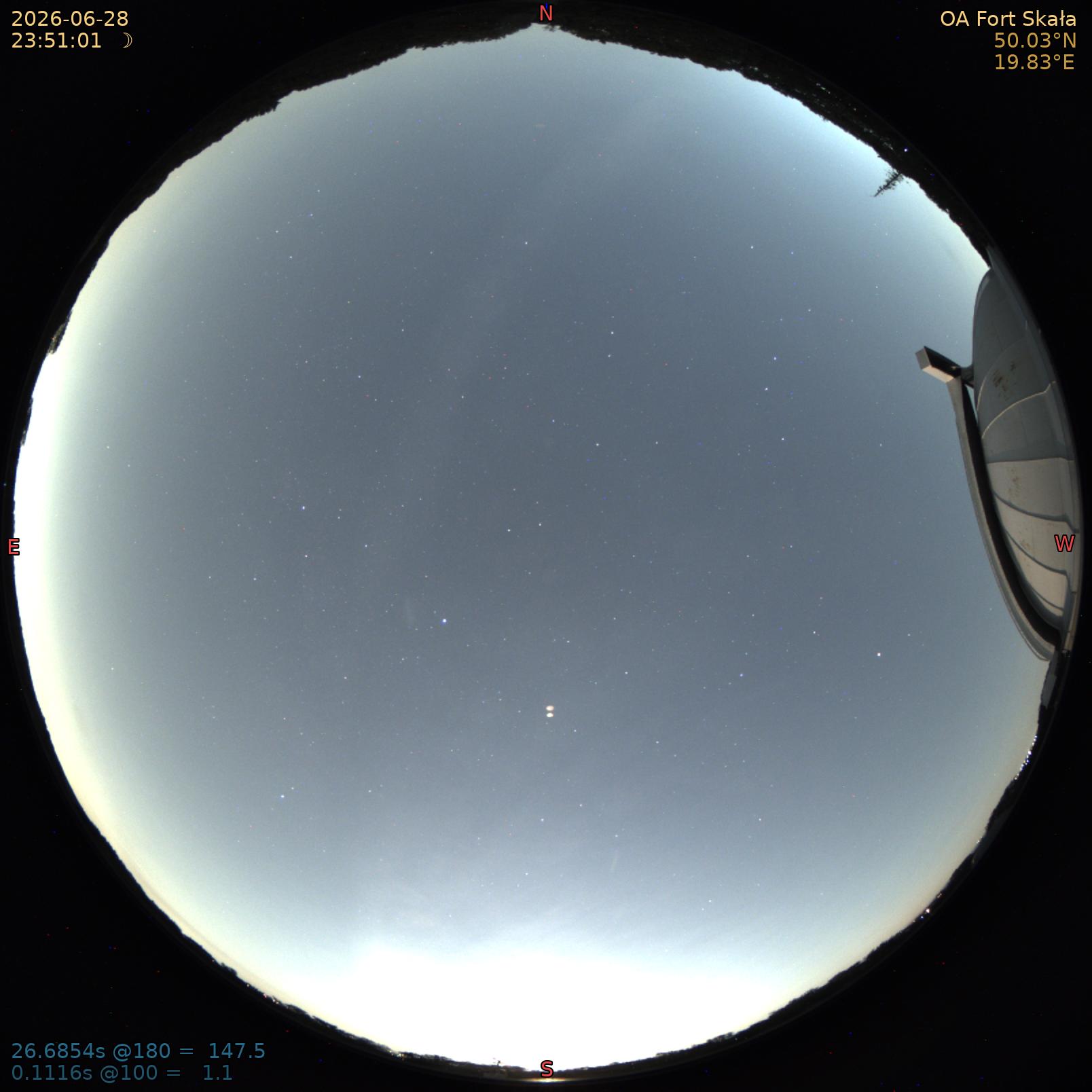
AllSky camera: OAUJ, Kraków

Sky above the JU Observatory in Kraków, exemplary shot. Sunny sky with few clouds.

News

OAUJ-CDK500: A new robotic telescope in Cracow

12.05.2026
We provide details of the OAUJ-CDK500, the newest optical telescope at the Astronomical Observatory of the Jagiellonian University, and the hardware and software which enables it to work autonomously as a telescope within the Skynet Robotic Telescope Network.
Read More o OAUJ-CDK500: A new robotic telescope in Cracow

Another Polish sky photo awarded by NASA

11.05.2026
Another photograph by Marcin Rosadziński has been selected by NASA as the Astronomy Picture of the Day (APOD) — marking the fifth time the photographer has been recognized by this prestigious website.
Read More o Another Polish sky photo awarded by NASA

The exhibition “Signal from the Abyss,” with the expert supervision of Dr. Arpita Misra

30.04.2026
We invite everyone to visit the exhibition of artists participating in the art and research project focused on the phenomenon of galactic jets—the largest known objects in space.
Read More o The exhibition “Signal from the Abyss,” with the expert supervision of Dr. Arpita Misra

The dual nature of radio emission in early-type galaxies

13.04.2026
Galaxies can be divided into two main types. Early-type galaxies are compact and consist mainly of old stars, and their radio emission is primarily associated with the activity of the central black hole. In contrast, late-type galaxies have characteristic spiral arms and a large population of young stars, which largely account for their radio emission. Even among early-type galaxies, however, we observe significant differences. Some of them emit radio waves from regions much larger than the galaxy itself, while others emit only from a small region around the center.
Read More o The dual nature of radio emission in early-type galaxies
Rakieta ze statkiem załogowym Orion wystartowała z Centrum Kosmicznego Kennedy'ego na Florydzie nocą z 1 na 2 kwietnia 2026, rozpoczynając dziesięciodniową, długo wyczekiwaną i wielokrotnie opóźnianą z ważnych względów bezpieczeństwa misję Artemis II. Misja początkowo planowana była na rok 2024, ale po usunięciu licznych awarii i usterek rakieta była (w teorii) gotowa do lotu dopiero z początkiem lutego 2026 roku. Tankowanie trzeba było jednak przerwać ze względu na problemy z wyciekiem paliwa.

Ostateczne odliczanie do udanego, kwietniowego startu rozpoczęto 30 marca. Także tutaj pojawiły się pewne problemy, które szczęśliwie udało się rozwiązać przed zamknięciem się okna startowego, czyli określonego czasu, w którym dana rakieta musi wystartować, aby osiągnąć właściwą trajektorię i dotrzeć do zaplanowanego celu. Niewielkie, niezagrażające misji usterki pojawiły się też w pierwszych godzinach lotu i wiązały się m.in. z funkcjonowaniem pokładowej toalety. Należy dodać, że tego rodzaju problemy są dosyć typowe, ze względu na złożoność technologii lotów kosmicznych.

Już kilkadziesiąt minut po starcie statek Orion znalazł się w odległości blisko 200 km od powierzchni Ziemi. Kolejny manewr wyniósł go znacznie wyżej - na orbitę okołoziemską z największym oddaleniem sięgającym 70 tysięcy km. W nocy z 2 na 3 kwietnia czasu polskiego kapsuła Orion przygotowywała się już do kluczowego manewru misji: wejścia na trajektorię prowadzącą do Księżyca, i już w tych dniach ludzie obecni na pokładzie znaleźli się w przestrzeni kosmicznej najdalej od czasów programu Apollo w latach 70. XX wieku. 

- 6 kwietnia, gdy w Polsce mieliśmy wczesny wieczór, amerykańsko-kanadyjska załoga - Gregory Wiseman, Victor Glover, Christina Koch i Jeremy Hansen - znaleźli się dosłownie w najbardziej oddalonym od reszty świata punkcie, do jakiego kiedykolwiek dotarł człowiek. Okrążając Księżyc, astronauci oddalili się od Ziemi na odległość ponad 400 tysięcy km! Kilka godzin później pobili i ten rekord, znajdując się najdalej od Ziemi w trakcie swojej misji, w odległości prawie 407 tysięcy km. Poprzedni taki rekord należał do załogi misji Apollo 13 w 1970 roku (400 171 km) - mówi dr Elżbieta Kuligowska z Obserwatorium Astronomicznego Uniwersytetu Jagiellońskiego (OA UJ).

I dodaje: - Czy to daleko? Tak duże liczby same niewiele nam mówią. Weźmy odległość 400 tysięcy kilometrów. Dla porównania, średnica Ziemi to niecałe 13 tysięcy km. Słońce jest odległe od Ziemi średnio o 150 milionów km, a Mars - kolejny ambitny cel przyszłych misji załogowych - nie zbliża się do Ziemi na mniej niż 55 milionów km. Przy takich porównaniach i skalach pokonanie odległości dzielącej nas od Księżyca, najbliższego dużego ciała niebieskiego, nie wydaje się czymś imponującym.

Z drugiej strony niecały rok temu fascynował nas lot Sławosza Uznańskiego-Wiśniewskiego na Międzynarodową Stację kosmiczną ISS. Lot także wiele razy przekładany i wiążący z licznymi zagrożeniami, również podczas powrotu na Ziemię. Nieco wcześniej dwoje amerykańskich astronautów utknęło na ISS na dziewięć miesięcy, ponieważ istniało poważne zagrożenie związane z ich sprowadzeniem na Ziemię. Tymczasem ISS krąży wokół Ziemi na wysokości

No one has ever gone this far before. Artemis II mission

08.04.2026
While most of us were celebrating Easter, the astronauts of the Artemis II mission traveled farther into space than anyone in history. The successful flight of the Orion Integrity capsule marked humanity’s symbolic return to the vicinity of the Moon after 54 years. And astronomers at the Jagiellonian University are helping us make sense of these complexities and are sharing the latest updates on progress in building the Jagiellonian University’s first-ever scientific satellite, which will investigate the origin of water on Earth.
Read More o No one has ever gone this far before. Artemis II mission

March 2026: The influence of standing gravitational waves on the shape of space-time

10.03.2026
Einstein's General Theory of Relativity has predicted the existence of gravitational waves for over a hundred years. However, their nonlinear nature still poses a problem for theorists today. One of the interesting theoretical questions in the theory of gravity is how the presence of gravitational waves affects the shape of spacetime itself.
Read More o March 2026: The influence of standing gravitational waves on the shape of space-time

'Reaching beyond the limits of sight' – a milestone in the history of global radio astronomy

19.02.2026
The European journal Astronomy & Astrophysics has just published an article describing the largest and most detailed radio survey of the sky. Among the researchers (from the Netherlands, Germany, France, Great Britain, Italy, Sweden, Ireland, Latvia, and Bulgaria, among others) involved in this globally unique project are also astronomers from Poland!
Read More o 'Reaching beyond the limits of sight' – a milestone in the history of global radio astronomy

Conference "From Astronomical Observations towards Cosmology and Philosophy of Nature"

06.02.2026
In Memory of Konrad Rudnicki in the 100th Anniversary of His Birth, Cracow, 2-3 July 2026
Read More o Conference "From Astronomical Observations towards Cosmology and Philosophy of Nature"