Research profile - Obserwatorium Astronomiczne im. Mikołaja Kopernika

Skip banner

A+ category

In the Evaluation of the quality of research activity for 2022–2025, the Ministry of Science and Higher Education awarded Jagiellonian University A+ rating in the field of astronomy.

Contact

Ul. Orla 171, 30-244 Kraków
Phone: 12 6238 620
For media & schools: press@oa.uj.edu.pl

Facebook icon
 

APOD

Astronomy Picture of the Day
 

Exemplary sky picture from the apod.pl/apod service: a dusty nebula


Study program

Positive assessment by the Polish Accreditation Committee

Hyper-Kamiokande

 Projekt „Hyper-Kamiokande” został zaakceptowany do finansowania w ramach programu „Wsparcie udziału polskich zespołów naukowych w międzynarodowych projektach infrastruktury badawczej” Ministerstwa Edukacji i Nauki.


Night under the Stars

Link to the event website
 

Decorational: Photo of the night sky with the central band of the Milky Way


Meteo

Forecast

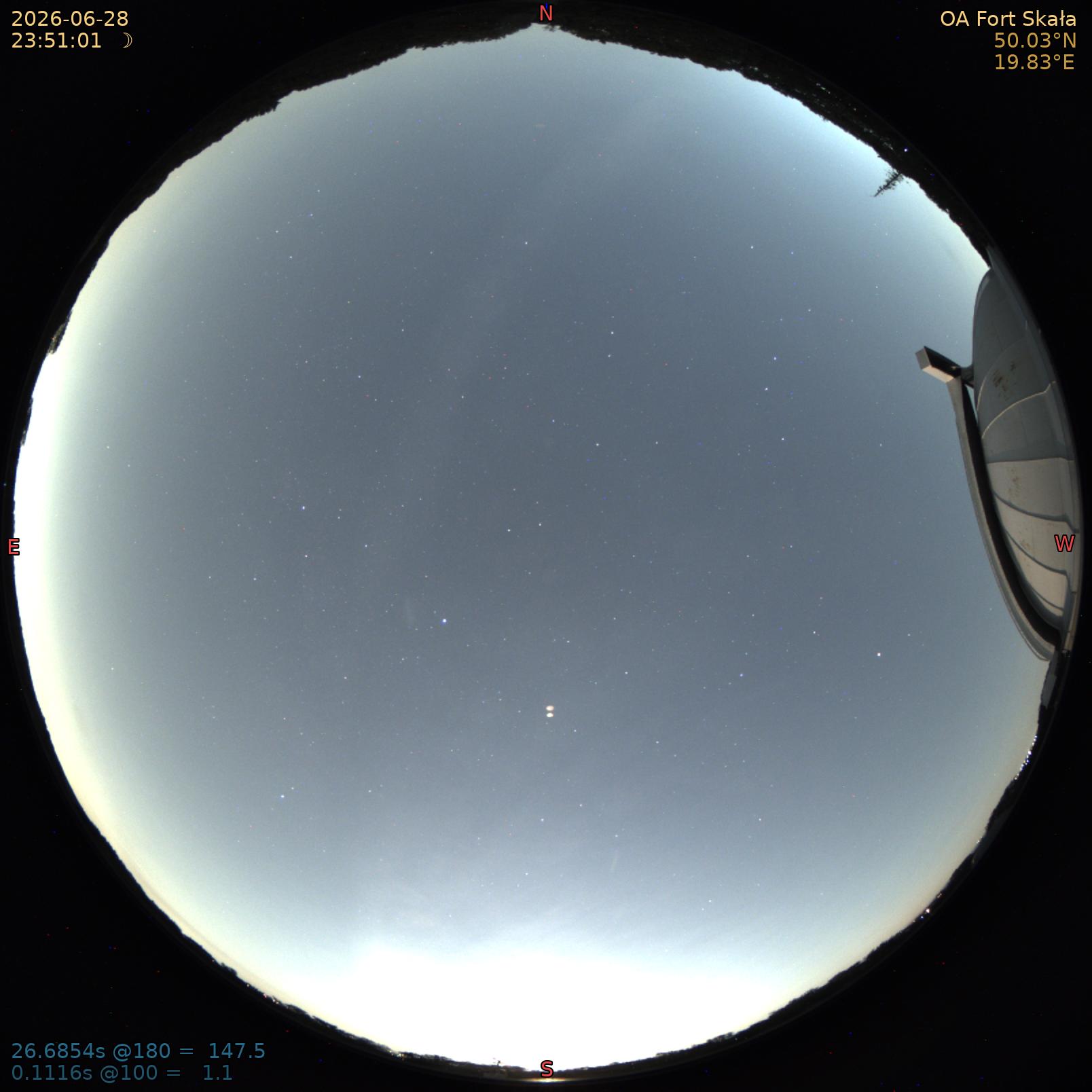
AllSky camera: OAUJ, Kraków

Sky above the JU Observatory in Kraków, exemplary shot. Sunny sky with few clouds.

Scientific Research

Department of High Energy Astrophysics

  • Gamma-ray astronomy - Collaborations High Energy Stereoscopic System (H.E.S.S.), Cherenkov Telescope Array (CTA) projects, and Fermi Large Area Telescope (LAT)
  • Astrophysics of accretion disks and relativistic jets
  • Cosmological evolution of supermassive black holes and active galaxies
  • Astrophysics of gamma-ray bursts
  • Heliophysics, including studies of coronal mass ejections
  • Studies of geophysical phenomena and heliospheric influences on Earth using measurements of extremely low frequency (ELF) electromagnetic waves
  • Acceleration and propagation of high-energy cosmic rays

Department of Radioastronomy and Space Physics

  • Investigation of gas and magnetic fields in galaxies, galaxy clusters, and intergalactic medium
  • Radio polarimetric observations of galaxies with largest radio telescopes and interferometric systems (EVLA, LOFAR, WSRT, ATCA, Effelsberg), and space observatories (XMM-Newton, Herschel)
  • Numerical modelling of evolution of cosmic magnetic fields and gravitational interactions of galaxies
  • Theoretical investigations of primordial cosmic structures: filaments and galactic superclusters
  • Research of planetary ionospheres

Department of Relativistic Astrophysics and Cosmology

  • Mathematical formulations of gravitational physics and their applications to astrophysics
  • The theory of structure formation in the early Universe
  • Gravitational lensing in cosmology
  • Chaos and critical phenomena in general relativity
  • Computer algebra systems with application to general relativity

Department of Stellar and Extragalactic Astronomy

  • Investigation of dynamical, physical and chemical processes in comets
  • Evolution of galaxies and large scale structures in the Universe
  • Investigation of spectrocscopic properties of active galaxies
  • Study of mechanisms of multiple radio activity in active galaxies
  • Investigation of properties of stars and stellar evolution