The sky above - Obserwatorium Astronomiczne im. Mikołaja Kopernika

Skip banner

A+ category

In the Evaluation of the quality of research activity for 2022–2025, the Ministry of Science and Higher Education awarded Jagiellonian University A+ rating in the field of astronomy.

Contact

Ul. Orla 171, 30-244 Kraków
Phone: 12 6238 620
For media & schools: press@oa.uj.edu.pl

Facebook icon
 

APOD

Astronomy Picture of the Day
 

Exemplary sky picture from the apod.pl/apod service: a dusty nebula


Study program

Positive assessment by the Polish Accreditation Committee

Hyper-Kamiokande

 Projekt „Hyper-Kamiokande” został zaakceptowany do finansowania w ramach programu „Wsparcie udziału polskich zespołów naukowych w międzynarodowych projektach infrastruktury badawczej” Ministerstwa Edukacji i Nauki.


Night under the Stars

Link to the event website
 

Decorational: Photo of the night sky with the central band of the Milky Way


Meteo

Forecast

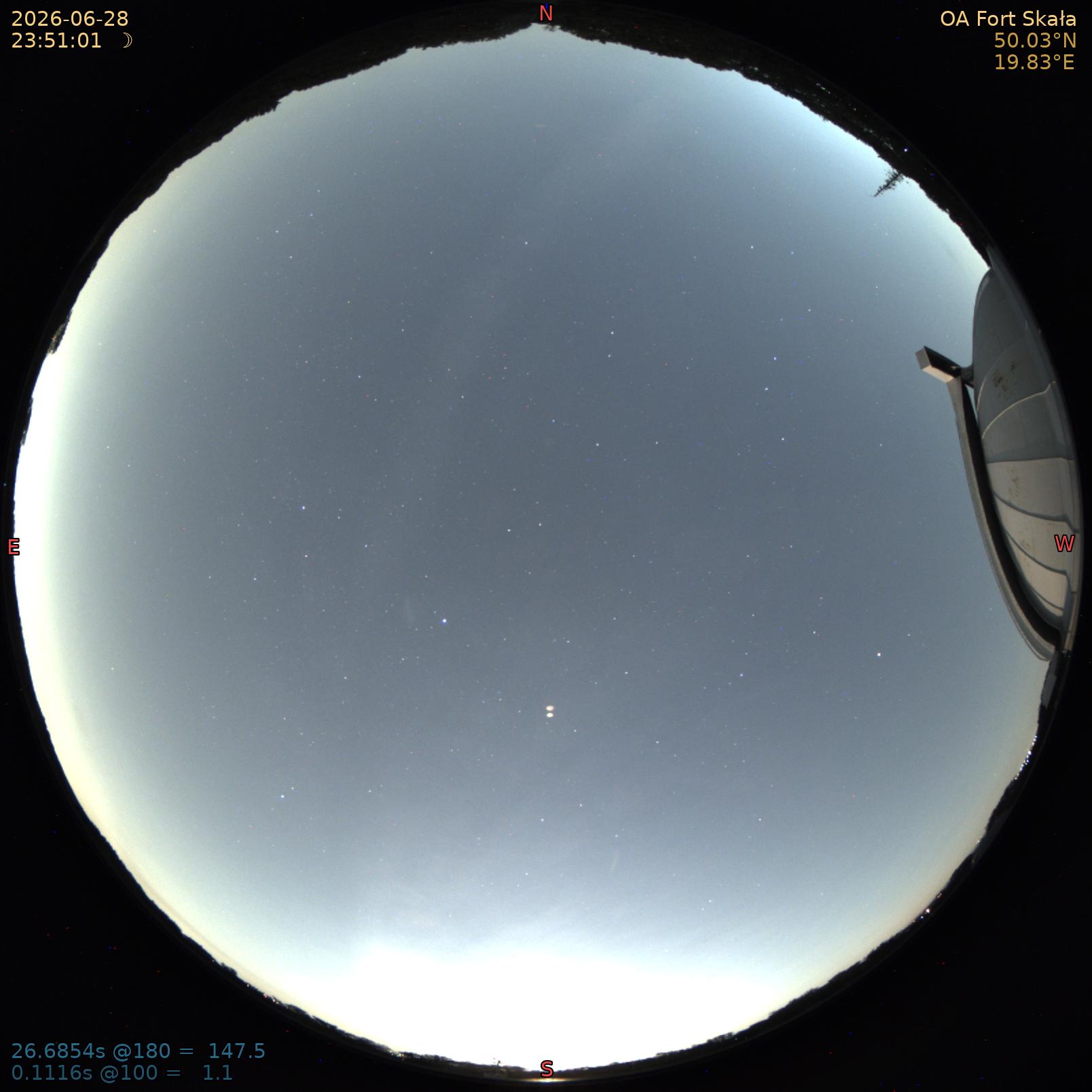
AllSky camera: OAUJ, Kraków

Sky above the JU Observatory in Kraków, exemplary shot. Sunny sky with few clouds.

On the sky

Meteory Geminidy -  Image Credit & Copyright: Wang Jin

Looking up at the December sky

24.11.2025
Astronomical winter starts this month. With this comes the opportunity to see interesting conjunctions of the Moon with some stars, Mercury, Jupiter, Saturn, and two great meteor showers.
Read More o Looking up at the December sky
listopad - jesień

A look at the November sky

10.11.2025
Autumn fog, cloud cover, and the associated haze often make it impossible to admire the night sky full of stars, while during the day, as the weather permits, we will be primarily interested in the Sun.
Read More o A look at the November sky
Niebo w październiku - miniatura

A glimpse of the October sky

29.09.2025
This month, the length of the day in the northern hemisphere is steadily decreasing, and we will have to accept this. In the Lesser Poland, the day will be 109 minutes shorter, from 11 hours and 39 minutes at the beginning of October to 9 hours and 50 minutes at the end of the month. On October 1, Sun rises at 6:40 a.m. and sets at 6:19 p.m. On the last day of the month, it rises at 6:28 a.m. and sets at 4:18 p.m. It's hard to believe, but this day will be 104 minutes longer than the shortest day of the year!
Read More o A glimpse of the October sky
Zaćmienie całkowite Księżyca

A look at the September sky

26.08.2025
The top event this September is a spectacular total lunar eclipse: September 7, peaking at 8:12 p.m.
Read More o A look at the September sky
Perseidy - widok nocnego nieba ze spadającymi meteorytami, zdjęcie Petra Horalka

Perseids – a night of falling (not) stars

04.08.2025
Meteors, commonly referred to by the somewhat misleading term "shooting stars", are the result of phenomena occurring much closer to us — in Earth's atmosphere. We observe their characteristic glow when a meteoroid, a small fragment of cosmic material, enters the atmosphere and burns up. In August, several meteor showers can be observed, but the Perseids, associated with the periodic comet 109P/Swift-Tuttle, are the most spectacular of them.
Read More o Perseids – a night of falling (not) stars