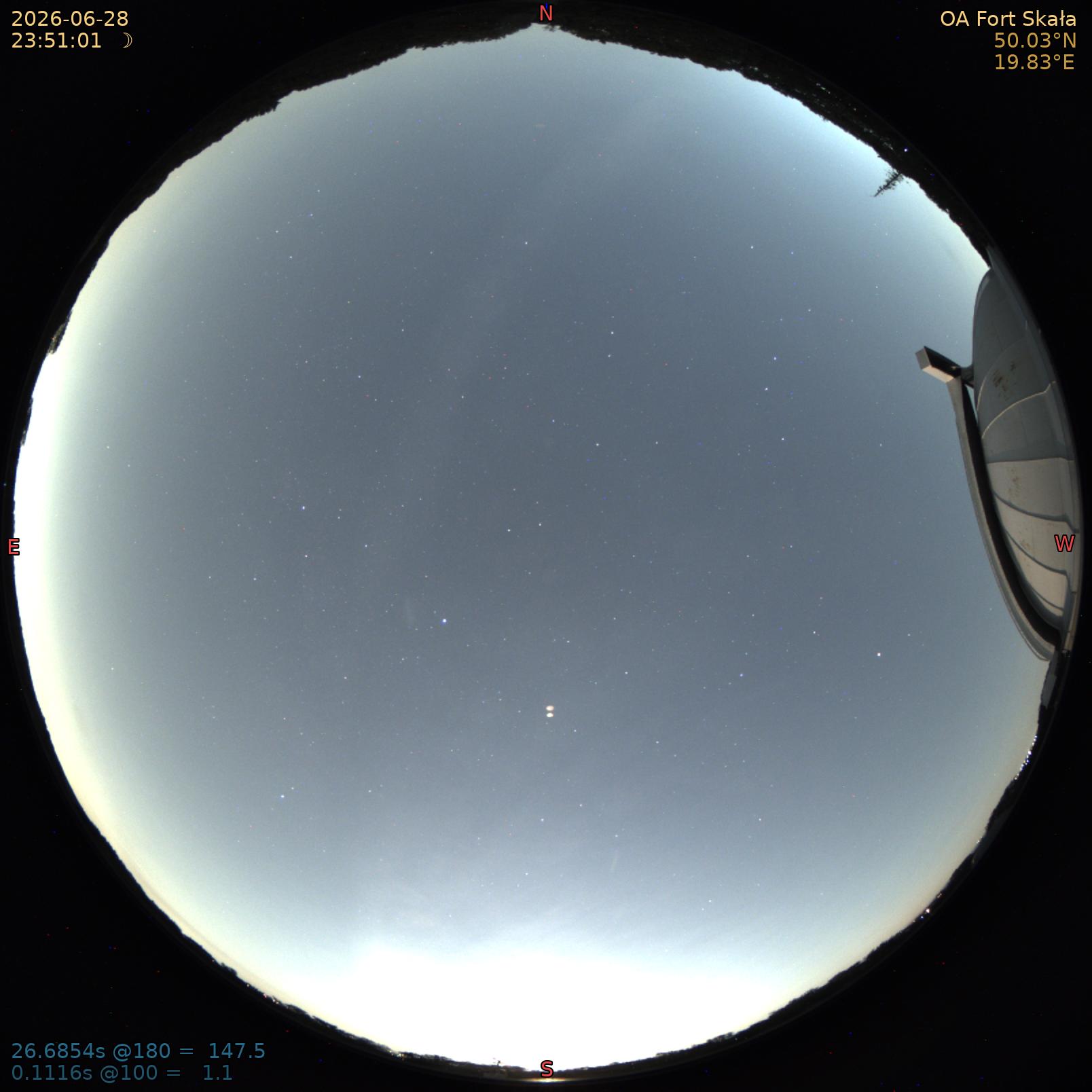
The Astronomical Observatory is an Institute within the Department of Physics, Astronomy and Applied Computer Science of the Jagiellonian University in Cracow. It is named after Nicolaus Copernicus and is based at Fort Skala, some 10 km (6 miles) west of the center of the city. Travel is through either of the settlements of Bielany or Zakamycze.
The University was founded in 1364, the Observatory - in 1792. Since that moment scientific program of the Observatory has covered observations of the positions of the Sun, the Moon and Jupiter satellites, stellar occultations, celestial mechanics of the Solar System and binary stars, meteorological observations, research of eclipsing binaries, the rotation and figure of the Moon. A detailed history of the Observatory is available.
Currently, there are about 40 scientists, actively carrying out research in the following fields: cometary physics, photometry and modelling of variable stars, the observation of radio emission from the Sun, extragalactic radio sources, active galagtic nuclei, the insterstellar and intergalactic medium, galactic physics, magnetic fields in the Universe and the large-scale structure of the Universe. The research is often in cooperation with a number of other institutions both in Poland and abroad, using a wide range of instruments and satellite observations.