News - Obserwatorium Astronomiczne im. Mikołaja Kopernika

Skip banner

A+ category

In the Evaluation of the quality of research activity for 2022–2025, the Ministry of Science and Higher Education awarded Jagiellonian University A+ rating in the field of astronomy.

Contact

Ul. Orla 171, 30-244 Kraków
Phone: 12 6238 620
For media & schools: press@oa.uj.edu.pl

Facebook icon
 

APOD

Astronomy Picture of the Day
 

Exemplary sky picture from the apod.pl/apod service: a dusty nebula


Study program

Positive assessment by the Polish Accreditation Committee

Hyper-Kamiokande

 Projekt „Hyper-Kamiokande” został zaakceptowany do finansowania w ramach programu „Wsparcie udziału polskich zespołów naukowych w międzynarodowych projektach infrastruktury badawczej” Ministerstwa Edukacji i Nauki.


Night under the Stars

Link to the event website
 

Decorational: Photo of the night sky with the central band of the Milky Way


Meteo

Forecast

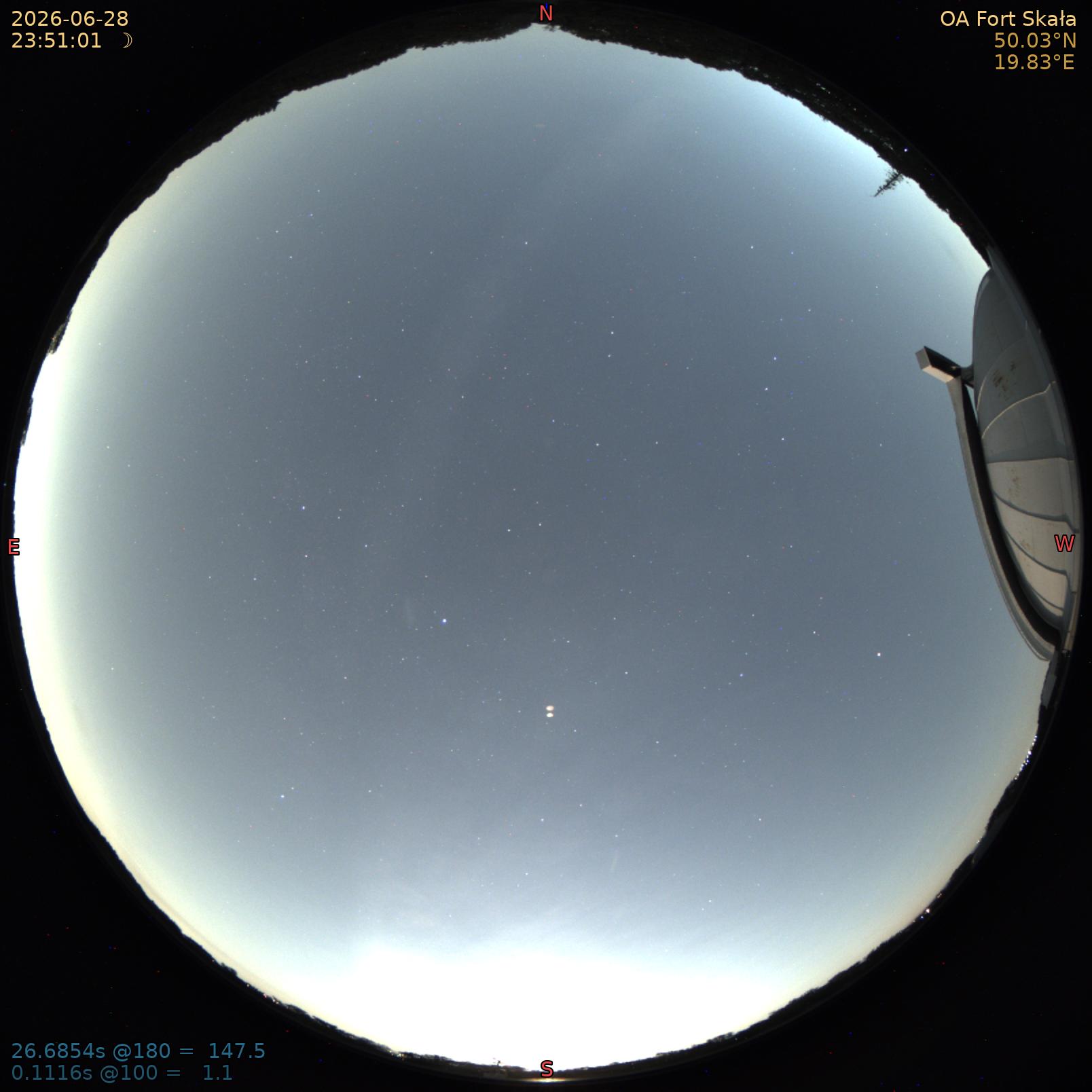
AllSky camera: OAUJ, Kraków

Sky above the JU Observatory in Kraków, exemplary shot. Sunny sky with few clouds.

News

Launch of the Polish Consortium for the SKA Observatory - September 16, 2025

17.09.2025
On Monday, September 15, at the Nicolaus Copernicus University Astronomical Observatory in Piwnice, Prof. Wojciech Macyk, PhD, Vice-Rector for Science at the Jagiellonian University, signed an agreement establishing the Polish Consortium for the SKA Observatory project.
Read More o Launch of the Polish Consortium for the SKA Observatory - September 16, 2025

September: Spirals can do it, too – a spiral host in a 2 Mpc double-double lobed radio galaxy

01.09.2025
Extragalactic jets, which are among the most powerful astrophysical phenomena, are collimated streams of gas ejected at high speeds from astronomical objects, in particular active galactic nuclei (AGNs). They can create huge clouds of matter bright at radio wavelengths, extending far beyond the boundaries of their host galaxy. If such sources reach sizes larger than 0.7 megaparsecs, we call them Giant Radio Galaxies (GRGs). Here we present an unusual object of this kind – a radio source J1350-1634 with two visible pairs of lobes, hosted by LEDA 896325 – the largest GRG hosted by a spiral galaxy known to date.
Read More o September: Spirals can do it, too – a spiral host in a 2 Mpc double-double lobed radio galaxy

Lesser Poland Researchers' Night 2025

26.08.2025
On the last Friday of September, you are welcome to visit our Observatory.
Read More o Lesser Poland Researchers' Night 2025

Planetary Science Conference 2025 – invitation

19.08.2025
The Planetary Science Conference 2025 will be held on October 23–25, 2025, at the Jagiellonian University in Krakow. This international scientific conference is dedicated to planetary science and space exploration. The event will be held in a hybrid format, and participation is free of charge, but requires prior registration.
Read More o Planetary Science Conference 2025 – invitation

August: Synthetic spectra from particle-in-cell simulations of relativistic jets with initial toroidal magnetic field

09.08.2025
Relativistic jets are observed across the entire electromagnetic spectrum in a variety of astrophysical systems, such as active galactic nuclei (AGNs), gamma-ray bursts (GRBs), and some black hole X-ray binaries, being launched from compact objects (black holes or neutron stars) typically surrounded by accretion discs. They are well-collimated outflows of plasma and fields, propagating with velocities close to the speed of light. Relativistic jets are supersonic, producing shocks that lead to a turbulent magnetic field, which can play an important role in acceleration of jet particles. They are also sources of kinetic instabilities driven by currents and shears as well as magnetic reconnection.
Read More o August: Synthetic spectra from particle-in-cell simulations of relativistic jets with initial toroidal magnetic field

Excavation of the Colossal Cavern for Hyper-Kamiokande Completed

05.08.2025
On July 31, 2025, the University of Tokyo completed excavation of the colossal cavern that will house the main detector volume of Hyper-Kamiokande, a next-generation, ultra-large water Cherenkov detector currently under construction in Hida City, Gifu, Japan.
Read More o Excavation of the Colossal Cavern for Hyper-Kamiokande Completed

July AOM: The most massive Black Hole Binary detected through gravitational waves

15.07.2025
On November 23, 2023, the LIGO-Virgo-KAGRA (LVK) collaboration detected GW231123, a gravitational-wave signal likely caused by the merger of two black holes with the highest combined mass the LVK collaboration has ever observed. These black holes would have been spinning incredibly fast, and their individual masses appear to fall into a range that challenges existing theories about how massive stars evolve and end their lives.
Read More o July AOM: The most massive Black Hole Binary detected through gravitational waves

Another extrasolar comet in the Solar System!

07.07.2025
Object from outside the Solar System is just passing through it at high speed.
Read More o Another extrasolar comet in the Solar System!