This year’s astronomical summer starts before noon on Sunday, June 21, at 10:25 a.m.—when the Sun, in its annual journey along the ecliptic, reaches its northernmost point from the celestial equator and marking the Summer Solstice
Summer Solstice
June is the season of the shortest nights, beautiful sunrises and sunsets, and the last spring strolls. We have short, warm nights, which, although not favorable for astronomical observations—since in June twilight practically turns into dawn, especially in the northern part of our country—are still precious to sky enthusiasts.
This year’s astronomical summer will start before noon on Sunday, June 21, at 10:25 a.m.—when the Sun, in its annual journey along the ecliptic, reaches its northernmost point from the celestial equator, marking the SummerSolstice On this day in Kraków, as the Sun crosses the meridian, it will rise above the horizon at an altitude of nearly 63.5 degrees. It rises at 4:30 a.m. and sets at 8:53 p.m., so the day will last 16 hours and 23 minutes; this will be the longest day (and shortest night) of the year, and 8 hours and 18 minutes longer than the shortest day of the year.
The earliest sunrise will be on June 15 (4:30 a.m.), and we will have such early sunrises for 8 days in a row. It will set latest on June 20 (at 8:53 p.m.), and there will be as many as 12 such late sunsets. We will experience the days when the Sun is above the horizon the longest throughout the week from June 17 to 24. During this period, on St. John’s Day (June 24), heavy rains often fall. After this year’s unpredictable spring, they may not occur—we will have to wait and watch. On Children’s Day, the Sun will rise at 4:36 a.m. and set at 8:40 p.m. The day will last 16 hours and 4 minutes; it will be 19 minutes shorter than the longest day of the year. On the last day of June, however, the Sun rises at 4:34 a.m. and sets at 8:53 p.m., and the day will be slightly shorter than the longest day of the year—by 4 minutes.
Magnetic activity of the Sun in June will most likely be quite high, peaking in the second half of the month, when we can expect seeing some Noctilucent Clouds in the evenings. Please remember that observations of sunspots should only be conducted using appropriate spectral filters or by projecting the image of the Sun from a telescope onto a screen. Those interested in such observations of Our Star are invited to the forecourt next to the Youth Astronomical Observatory, where special solar shows will be organised on clear days throughout the summer holidays.
Moon
The Moon welcomes summer in its first quarter. We’ll have very short, moonless nights in the middle of the month, and the Moon phases will follow this order:
Last quarter – 8 VI
New Moon – 15 VI
First quarter – 21 VI
Full Moon – 30 VI.
The Moon will reach apogee (its farthest point from Earth) twice: on June 1 at 6:32 a.m. and on June 28 at 9:11 a.m., and it will reach perigee (its closest point to Earth) on June 15 at 1:18 a.m.
In June, the Moon will come very close in the evening sky to the planets Mercury (June 16) and Venus (June 17). These phenomena will be observable here at their optimal moments of closest approach.
Planets and meteors
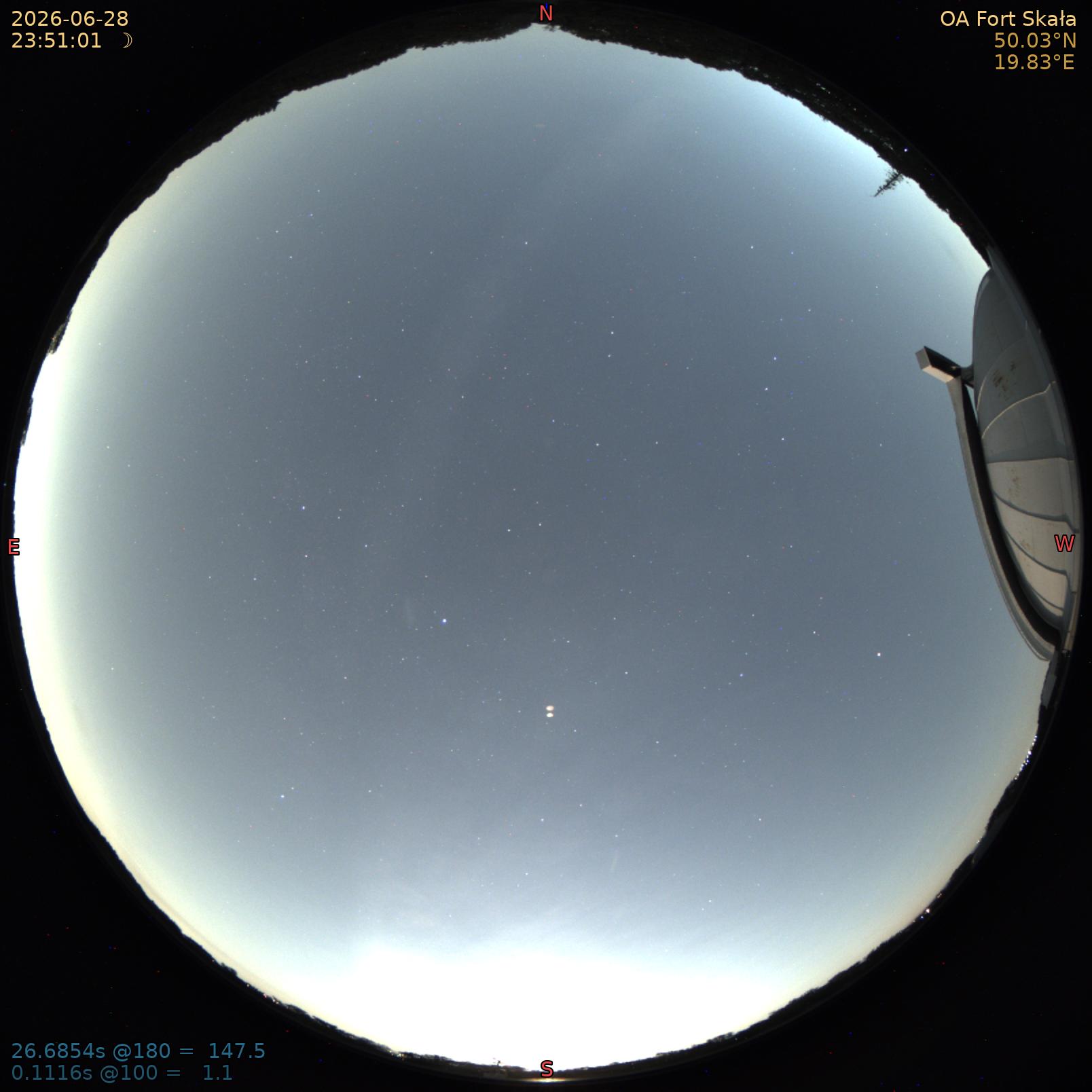
In June, Venus, Jupiter, and Mercury will be visible in the evening sky, while Saturn, Mars, Neptune, and Uranus can be seen in the morning sky. Bright Venus, as the Evening Star, shall also dominate the twilight sky, and Saturn is to precede the sunrise by a full three hours after midnight. A beautiful phenomenon will take place on the evening of June 9 at 10 p.m., when Venus and Jupiter reach their closest approach in the sky during the evening twilight.
From June 22 to July 2, there will be a chance to count slow meteors from the June Bootid meteor shower (radiating from the constellation Boötes). Their peak activity falls on June 28, and the nearly full Moon will unfortunately slightly interfere with nighttime observations.
Illustration: The sky as seen on the evening of June 9: conjunction of Venus and Jupiter (map source: Stellarium)