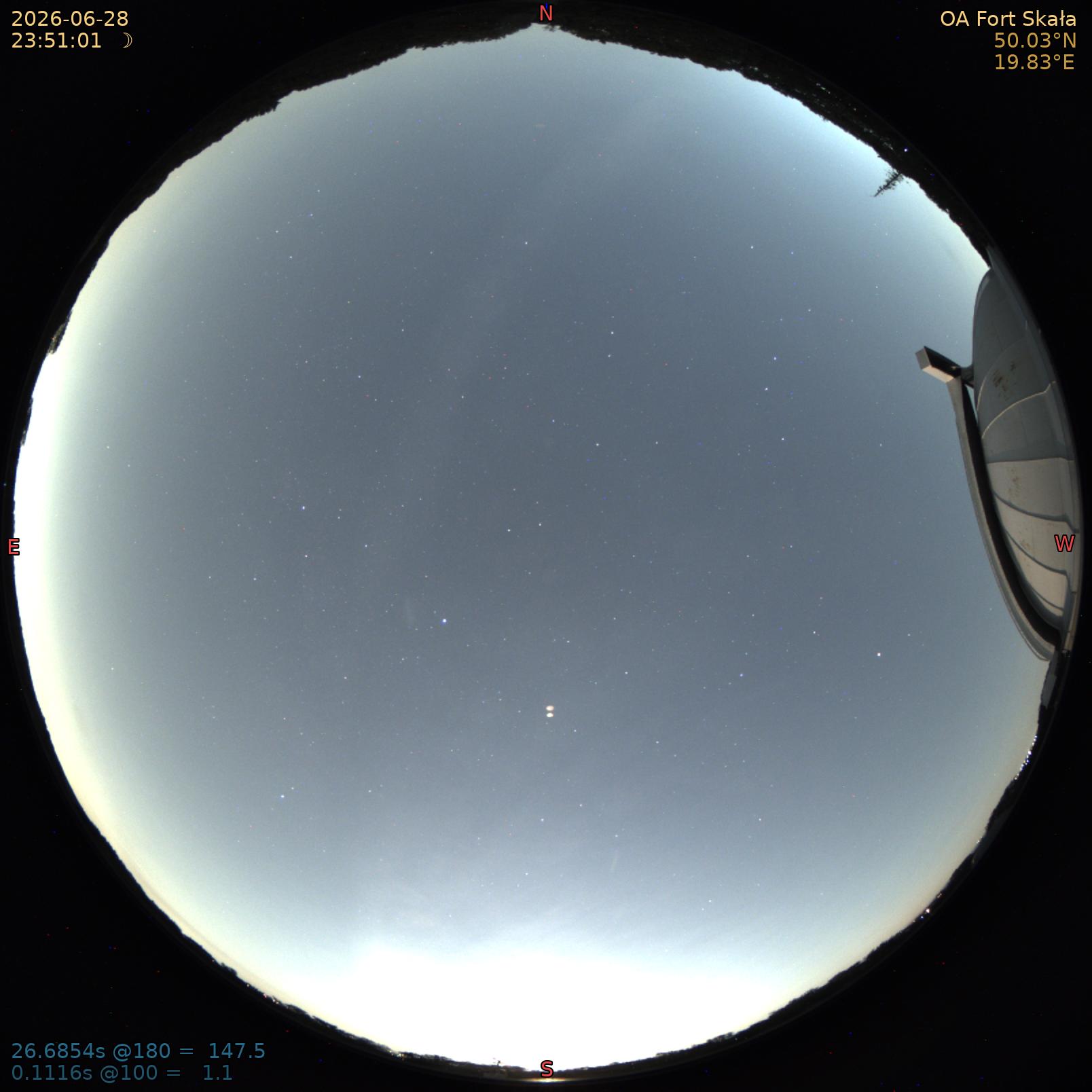
Summer brings long days and very short nights, which does not exactly make for ideal conditions for stargazing; however, there will be many interesting phenomena to observe in the sky during this year’s summer holidays. The August total solar eclipse—visible in Poland as a partial one—is undoubtedly the highlight of the month, alongside the spectacular Perseids and a lunar eclipse.
The Earth and the Sun
During the second week of summer break, on the afternoon of July 6, Earth will reach its farthest point from the Sun (known as aphelion) in its orbit, which is over 152 million kilometres away. Meanwhile, as the Sun travels along the ecliptic, it is slowly moving toward the celestial equator, causing its declination to decrease steadily; as a result, nights will become slightly, but progressively, longer, and days progressively shorter.
In Kraków on July 1, the Sun rises at 4:35 a.m. and sets at 8:52 p.m.; the day will last 16 hours and 17 minutes. It will be 6 minutes shorter than the longest day of the year; on August 31, however, the Sun rises at 5:54 a.m. and sets at 7:26 p.m., meaning it will shine for 13 hours and 32 minutes: this translates into a loss of 2 hours and 45 minutes of daylight over the summer. Meanwhile, as the Sun “travels” against the backdrop of the constellations, it will move from Cancer to Leo on July 22, and a month later it will enter the constellation Virgo. The Sun's magnetic activity remains at an average level. It may increase slightly by the end of August, a visible sign of which might be a modest increase in the number of sunspots and flares in the Sun's photosphere. We should also still expect surprises from our star, including solar flares and plasma ejections into interplanetary space, which may or may not result in the possibility of observing the aurora borealis even in Lesser Poland.
Summer constellations
In the southeastern sky, when it gets dark enough (which in July isn’t until around 11 p.m.), the asterism known as the Summer Triangle comes into view. It is formed by three first-magnitude stars: Deneb, Vega, and Altair. They belong, in that order, to the constellations Cygnus, Lyra, and Aquila. The part of the triangle highest above the horizon contains almost the entire Cygnus constellation (its bright stars form a cross); to the right, slightly below, is Lyra, and at the bottom is Aquila. All three constellations are set against the background of the Milky Way, our Galaxy. To spot it, all you need is a keen eye and a few moments on a late, clear summer evening—but away from areas affected by scattered light.
Moon
The Moon will start and end the summer break following the last quarter. The sequence of its phases in July will be as follows:
Last quarter: July 7 at 9:29 p.m.
New moon: July 14 at 11:43 a.m.
First quarter: July 21 at 1:06 p.m.
Full moon: July 29 at 4:36 p.m.
In August:
Last quarter: August 6 at 4:21 a.m.
New moon: August 12 at 7:37 p.m. (solar eclipse)
First quarter: August 20 at 4:46 a.m.
Full moon: August 28 at 6:18 a.m. (lunar eclipse).
The Moon will be at perigee (closest to Earth) on July 13 at 10 a.m. and on August 10 at 1 p.m. It will be at apogee (furthest from Earth) on July 25 at 7 p.m. and August 22 at 10 a.m. A Total Solar Eclipse in Europe will be visible in Greenland, Iceland, and parts of Spain. In Poland, it will be only partially visible, beginning at 7:15 p.m., peaking at 8:07 p.m., and ending at 8:56 p.m. Meanwhile, the Partial Lunar Eclipse on August 28 will begin at 4:33 a.m., peak at 6:13 a.m., and end below the horizon in Kraków.
Moreover, as the Moon travels across the summer night sky, it will approach the Pleiades after midnight (July 11) and Venus in the evening (July 17 ) — phenomena that we will be able to observe if the weather will be fine.
It’s worth remembering that July 20 marks the 57th anniversary of the Apollo 11 spacecraft’s landing on the Moon, and that one day later, human feet (those of Neil Armstrong and Buzz Aldrin) touched the surface of the Moon for the first time.
Path of totality for the August solar eclipse (via Time and Date website)
Planets
Mercury will be visible in the morning sky, low above the eastern horizon, but only from July 12 to August 22. After that, it will be hidden by the sunlight. The best conditions for observing it occur at the end of July and beginning of August, when it will be nearly 20 degrees away from the Sun in the sky, rising more than an hour before the Sun.
Venus can be seen in the evening sky the whole summer, acting as the Evening Star, and it won’t set until a full two hours after the Sun, getting bathed in the evening glow. It will reach its maximum brightness on August 15, when its western elongation — its greatest distance from the Sun in the sky — will be 46 degrees.
Mars, in the constellation Taurus, will be visible after midnight. By the end of the summer, it will be rising three hours before sunrise. It won’t reach opposition until February 19, 2027, and at that time, it will be visible all night long.
Jupiter, along with its group of Galilean moons, is spending this summer in the Cancer and will be basking in the Sun’s rays throughout the summer, so will not be visible in our skies. Its conjunction with the Sun takes place on July 29.
Saturn, adorned with rings that can be admired through a small telescope, is currently in the constellation Pisces. At the start of summer holiday, it rises before midnight and gradually appears earlier and earlier before sunrise. However, it will not be in opposition to the Sun until October 4.
Uranus and Neptune will appear in the latter half of the night, in the Taurus and Pisces. The end of summer holiday will be a particularly good time to observe Neptune, which is now travelling across the sky alongside Saturn, and with its opposition occurring on September 19. At the start of summer, Uranus travels across the sky close to Mars, and by the end of the break, it precedes the sunrise by more than four hours. To spot these distant planets, however, you will need to use a telescope.
Other phenomena
In the second half of July, with a peak of 28, we can watch slow meteors from the Aquarid meteor shower, whose radiant lies in the constellation Aquarius; and during evening observations, we will be hindered by the Moon, which will be nearly full by then. However, from July 17 to August 24, the Perseids—known to people for centuries and also called the Tears of St. Lawrence—will be active. Its main, extended peak occurs on August 12 and during the night of August 12–13. The New Moon will not interfere with your observations, and the earlier solar eclipse can only increase our appetite for stargazing. So we invite everyone to observe this famous meteor shower—it’s worth staying up a bit late on Wednesday night to see these numerous “shooting stars.” Let’s also remember the old Polish weather saying: What July and August don’t bring, September won’t fry.