News - Obserwatorium Astronomiczne im. Mikołaja Kopernika

Skip banner

A+ category

In the Evaluation of the quality of research activity for 2022–2025, the Ministry of Science and Higher Education awarded Jagiellonian University A+ rating in the field of astronomy.

Contact

Ul. Orla 171, 30-244 Kraków
Phone: 12 6238 620
For media & schools: press@oa.uj.edu.pl

Facebook icon
 

APOD

Astronomy Picture of the Day
 

Exemplary sky picture from the apod.pl/apod service: a dusty nebula


Study program

Positive assessment by the Polish Accreditation Committee

Hyper-Kamiokande

 Projekt „Hyper-Kamiokande” został zaakceptowany do finansowania w ramach programu „Wsparcie udziału polskich zespołów naukowych w międzynarodowych projektach infrastruktury badawczej” Ministerstwa Edukacji i Nauki.


Night under the Stars

Link to the event website
 

Decorational: Photo of the night sky with the central band of the Milky Way


Meteo

Forecast

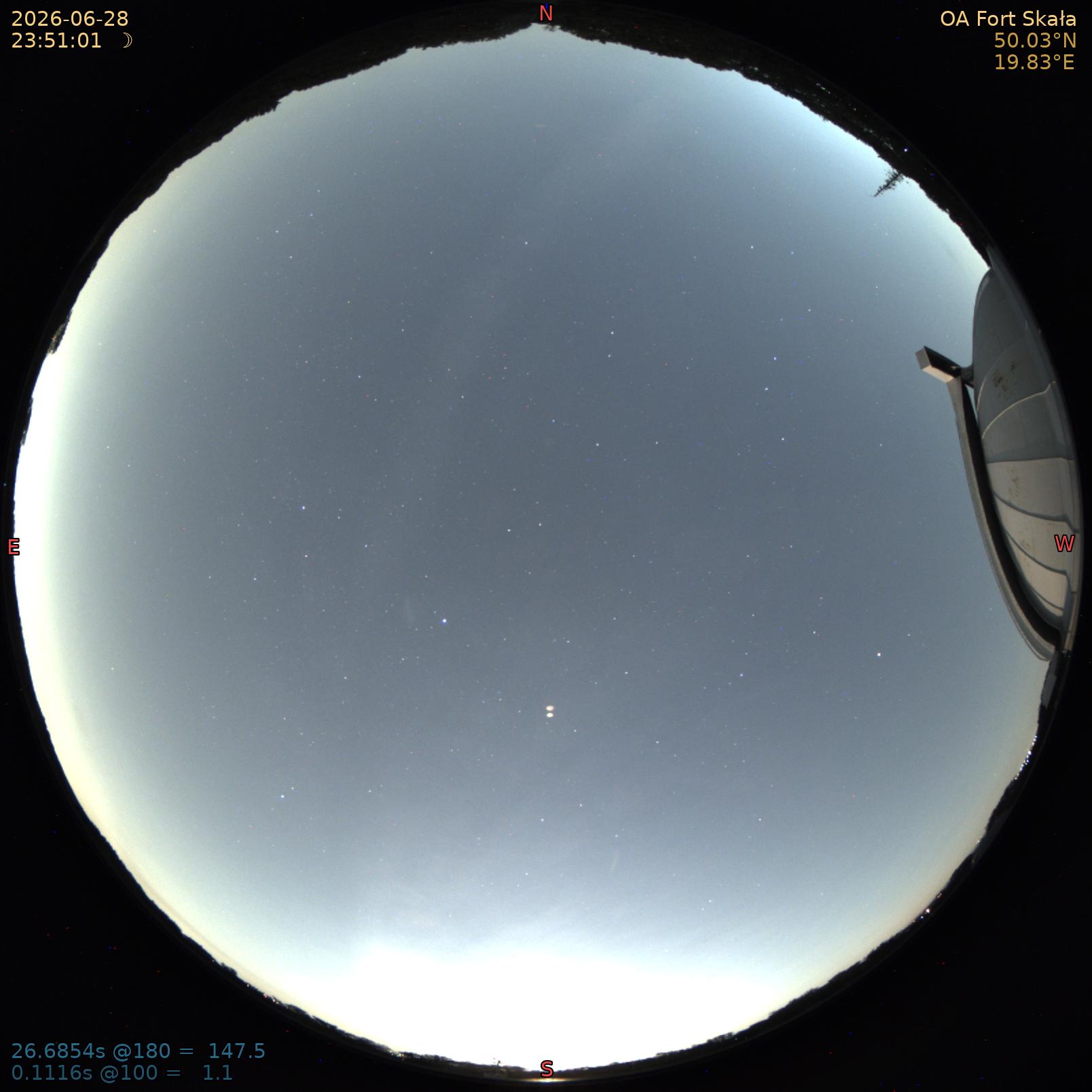
AllSky camera: OAUJ, Kraków

Sky above the JU Observatory in Kraków, exemplary shot. Sunny sky with few clouds.

News

Meteor hunting online 24/7— live space stream at OAUJ

15.07.2026
We have launched a live stream at our Observatory! Did you know that meteors can not only be seen but also detected using antennas? Even during the day, whatever the weather—clouds or rain. There are currently two radio meteor observation stations operating at the Observatory at Fort. They use the phenomenon of radio echoes.
Read More o Meteor hunting online 24/7— live space stream at OAUJ

Life after life of radio galaxies – the repeated death and resumption of activity of supermassive black holes

14.07.2026
Among the several million radio galaxies discovered to date, astronomers have recently identified several peculiar classes that deviate from the classical view of these objects. Studying unusual giant double-double radio galaxies is helping astronomers understand the nature of active supermassive black holes located at the centers of some galaxies.
Read More o Life after life of radio galaxies – the repeated death and resumption of activity of supermassive black holes

Międzynarodowy Dzień Planetoid

23.06.2026
30 czerwca 2026 r. zapraszamy do wspólnego obchodzenia Międzynarodowego Dnia Planetoid na Wydziale Fizyki, Astronomii i Informatyki Stosowanej UJ oraz w Obserwatorium Astronomicznym UJ. W programie znajdą się wykłady popularnonaukowe, warsztaty, przejazd zabytkowym autobusem (Jelcz RTO 272 MEX) oraz wieczorne zwiedzanie Obserwatorium połączone z obserwacjami nieba.
Read More o Międzynarodowy Dzień Planetoid

New pulsating hot subdwarfs discovered with the TESS satellite

07.06.2026
International team of astronomers led by Jerzy Krzesiński has discovered 42 new hot subdwarfs, including 22 new pulsating stars, 3 candidates for systems containing a pulsating hot subdwarf, and 13 new candidates for close binary star pairs. The discoveries are based on the analysis of observations made by the TESS satellite, monitoring changes in the brightness of millions of stars in the sky.
Read More o New pulsating hot subdwarfs discovered with the TESS satellite

OAUJ-CDK500: A new robotic telescope in Cracow

12.05.2026
We provide details of the OAUJ-CDK500, the newest optical telescope at the Astronomical Observatory of the Jagiellonian University, and the hardware and software which enables it to work autonomously as a telescope within the Skynet Robotic Telescope Network.
Read More o OAUJ-CDK500: A new robotic telescope in Cracow

Another Polish sky photo awarded by NASA

11.05.2026
Another photograph by Marcin Rosadziński has been selected by NASA as the Astronomy Picture of the Day (APOD) — marking the fifth time the photographer has been recognized by this prestigious website.
Read More o Another Polish sky photo awarded by NASA

The exhibition “Signal from the Abyss,” with the expert supervision of Dr. Arpita Misra

30.04.2026
We invite everyone to visit the exhibition of artists participating in the art and research project focused on the phenomenon of galactic jets—the largest known objects in space.
Read More o The exhibition “Signal from the Abyss,” with the expert supervision of Dr. Arpita Misra

The dual nature of radio emission in early-type galaxies

13.04.2026
Galaxies can be divided into two main types. Early-type galaxies are compact and consist mainly of old stars, and their radio emission is primarily associated with the activity of the central black hole. In contrast, late-type galaxies have characteristic spiral arms and a large population of young stars, which largely account for their radio emission. Even among early-type galaxies, however, we observe significant differences. Some of them emit radio waves from regions much larger than the galaxy itself, while others emit only from a small region around the center.
Read More o The dual nature of radio emission in early-type galaxies