News - Obserwatorium Astronomiczne im. Mikołaja Kopernika

Skip banner

A+ category

In the Evaluation of the quality of research activity for 2022–2025, the Ministry of Science and Higher Education awarded Jagiellonian University A+ rating in the field of astronomy.

Contact

Ul. Orla 171, 30-244 Kraków
Phone: 12 6238 620
For media & schools: press@oa.uj.edu.pl

Facebook icon
 

APOD

Astronomy Picture of the Day
 

Exemplary sky picture from the apod.pl/apod service: a dusty nebula


Study program

Positive assessment by the Polish Accreditation Committee

Hyper-Kamiokande

 Projekt „Hyper-Kamiokande” został zaakceptowany do finansowania w ramach programu „Wsparcie udziału polskich zespołów naukowych w międzynarodowych projektach infrastruktury badawczej” Ministerstwa Edukacji i Nauki.


Night under the Stars

Link to the event website
 

Decorational: Photo of the night sky with the central band of the Milky Way


Meteo

Forecast

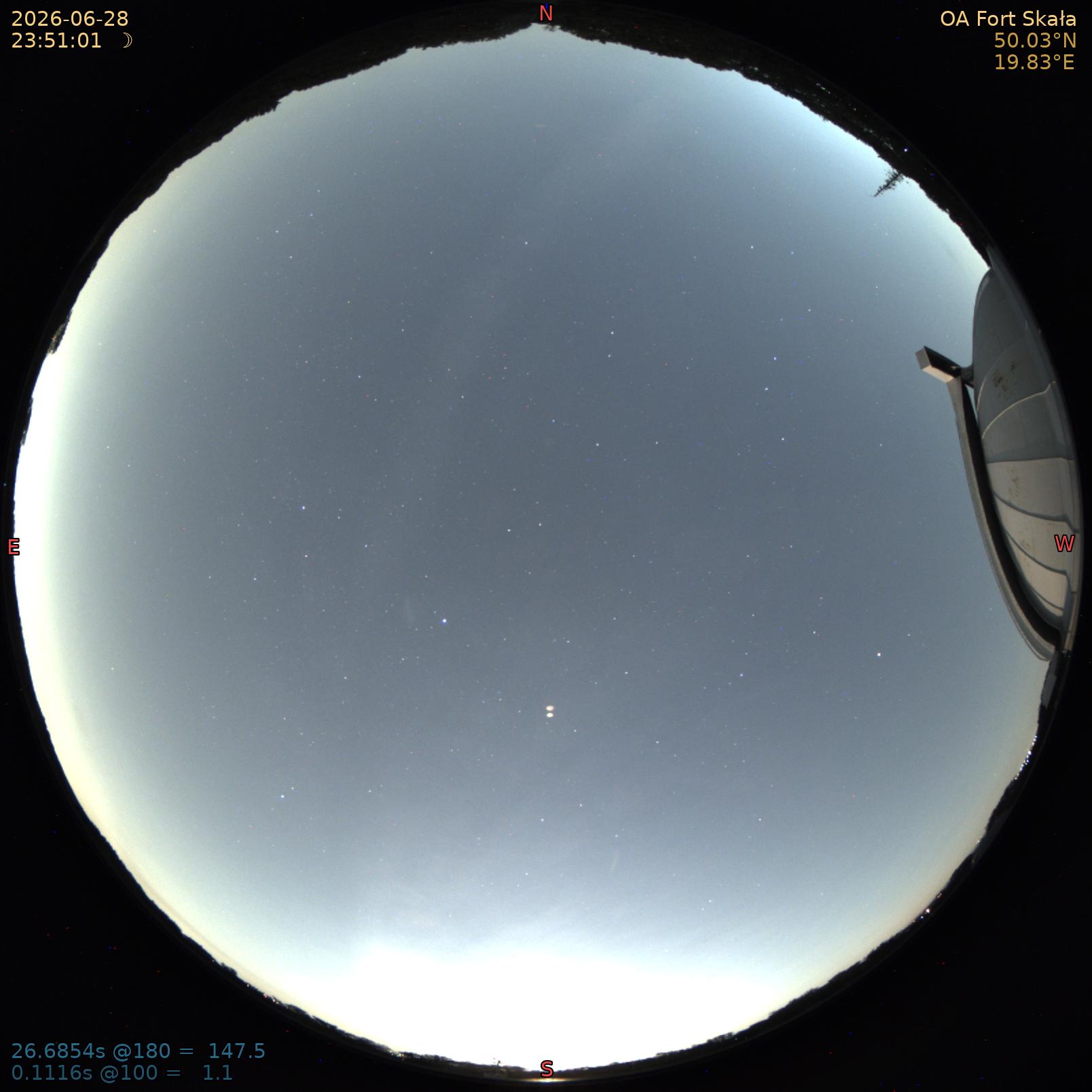
AllSky camera: OAUJ, Kraków

Sky above the JU Observatory in Kraków, exemplary shot. Sunny sky with few clouds.

News

November: A Wide-Band High-Frequency Type-II Solar Radio Burst

10.11.2025
Type-II radio bursts are usually observed below 400 MHz with slowly-drifting narrow fundamental and/or harmonic bands. Events with starting frequencies higher than 400 MHz are rarely reported (e.g., Pohjolainen et al. 2008). Such high-frequency Type-IIs may stem from the CME interaction with surrounding dense structures in the corona, such as streamers, ray-like or loop structure, or from sources in the lower corona.
Read More o November: A Wide-Band High-Frequency Type-II Solar Radio Burst

Grzegorz Sęk - in memoriam

10.11.2025
On Friday, November 7, we received the sad news on the passing of Grzegorz Sęk – a teacher, educator, and astronomer also associated with our Observatory.
Read More o Grzegorz Sęk - in memoriam

October: GWTC-4.0 – observations from Part I of the 4th LIGO-VIRGO-KAGRA campaign

02.10.2025
In August 2025, the LIGO-Virgo-KAGRA (LVK) Collaborations released the interferometric strain data from the first part of the fourth observing run (O4a), which ran from May 2023 to January 2024. In this data, we have discovered 128 new confident gravitational-wave signals originating from merging black holes and neutron stars. Alongside the strain data release, we publish version 4.0 of the Gravitational Wave Transient Catalog (GWTC-4.0), which contains lists of the candidate signals and measurements of their properties.
Read More o October: GWTC-4.0 – observations from Part I of the 4th LIGO-VIRGO-KAGRA campaign

Visit by Nobel laureate Takaaki Kajita, discoverer of neutrino oscillations

29.09.2025
A week ago, during the “II EU Workshop on Water Cherenkov Experiments for Precision Physics” conference co-organized by the OAUJ, Jagiellonian University hosted Japanese physicist Takaaki Kajita, who, together with Canadian Arthur B. McDonald, received the 2015 Nobel Prize in Physics for the discovery of neutrino oscillations. “This discovery has changed our understanding of the deepest secrets of matter and may prove crucial to our understanding of the Universe,” the Nobel Committee explained.
Read More o Visit by Nobel laureate Takaaki Kajita, discoverer of neutrino oscillations

Launch of the Polish Consortium for the SKA Observatory - September 16, 2025

17.09.2025
On Monday, September 15, at the Nicolaus Copernicus University Astronomical Observatory in Piwnice, Prof. Wojciech Macyk, PhD, Vice-Rector for Science at the Jagiellonian University, signed an agreement establishing the Polish Consortium for the SKA Observatory project.
Read More o Launch of the Polish Consortium for the SKA Observatory - September 16, 2025

September: Spirals can do it, too – a spiral host in a 2 Mpc double-double lobed radio galaxy

01.09.2025
Extragalactic jets, which are among the most powerful astrophysical phenomena, are collimated streams of gas ejected at high speeds from astronomical objects, in particular active galactic nuclei (AGNs). They can create huge clouds of matter bright at radio wavelengths, extending far beyond the boundaries of their host galaxy. If such sources reach sizes larger than 0.7 megaparsecs, we call them Giant Radio Galaxies (GRGs). Here we present an unusual object of this kind – a radio source J1350-1634 with two visible pairs of lobes, hosted by LEDA 896325 – the largest GRG hosted by a spiral galaxy known to date.
Read More o September: Spirals can do it, too – a spiral host in a 2 Mpc double-double lobed radio galaxy

Lesser Poland Researchers' Night 2025

26.08.2025
On the last Friday of September, you are welcome to visit our Observatory.
Read More o Lesser Poland Researchers' Night 2025

Planetary Science Conference 2025 – invitation

19.08.2025
The Planetary Science Conference 2025 will be held on October 23–25, 2025, at the Jagiellonian University in Krakow. This international scientific conference is dedicated to planetary science and space exploration. The event will be held in a hybrid format, and participation is free of charge, but requires prior registration.
Read More o Planetary Science Conference 2025 – invitation